Customer service
involves much more than answering questions over the phone. Responding to
tickets through email, live chat, and social media are equally important
communication channels for customers. While there’s plenty of overlap in the
customer service skills required to do a great job, each customer service
channel benefits from a unique approach to these skills.
For example, there are important customer service skills
associated with phone support, such as empathy, the ability to “read” a
customer’s emotional state, clear communication, and friendliness. But things
emotional cues are much harder to read in writing, so additional customer
service skills for newer customer-facing channels need to be developed and
improved upon (in order to make those channels more viable for customers).
Whether you’re interviewing or brushing up your customer service
skills for your resume, it’s good to remember that most customer support
managers aren’t just interviewing for technical skills. They’ll be looking for
team members that can demonstrate real customer service skills.
The following examples are the good customer service skills that
all customer service professionals strive to master:
Keep It Simple
1. Smile, literally
Smiles translate through the phone but should be used at appropriate
times. You don’t want your customer service to come off as inauthentic, but you
should still always be cordial during conversations. Smile as you would in a
face-to-face conversation while responding to questions and conveying necessary
information.
Keep It Simple
2. Mirror a customer’s’ language and tone
Part of the job in customer service is mirroring a customer’s
language and tone. Mirroring another person’s language and tone can help create
a connection. That said, if a customer is angry, you don’t want to copy their
frustration. Instead, you can try increasing your volume just a little and then
quickly work to bring the intensity down a notch. Customers respond well when
the help they’re receiving is coming from someone who’s clearly level-headed.
Keep It Simple
3. Listen first, then validate the problem
When customers are upset or frustrated, they might not be able
to take in what you say—even if it’s the right answer. Listen first, let them
calm down, and then try to help solve their problems. Empathy is a crucial
ability in customer service, so make sure you know exactly what you’re showing
empathy towards.
Keep It Simple
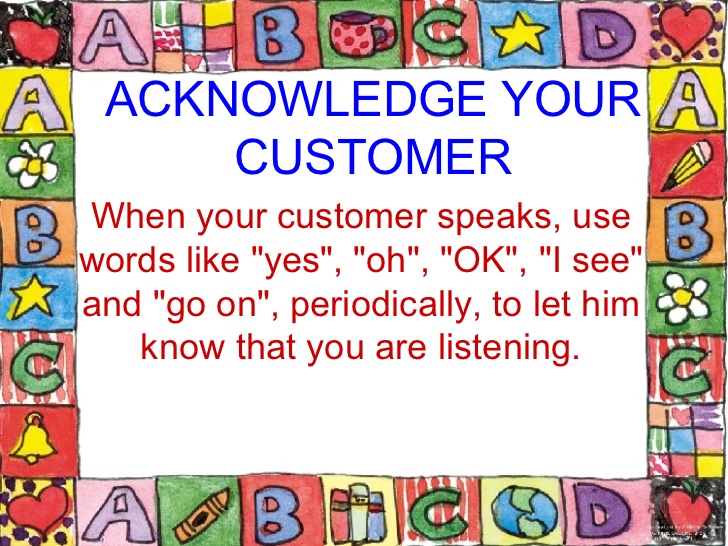
4. Acknowledge the customer
Customers need to feel heard, so tell them that you understand
the reason for their call. They’ll appreciate the touch of empathy and it’ll go
a long way towards making an angry customer’s experience much better. Customer
service that accurately recognizes what ails the customer comes off as more
human and reflects well on the company.
Keep It Simple
5. Summarize your help
You’ve got to listen to a customer’s problems in order to repeat
information to them with supportive language, and do so in a way that
summarizes the help that you’re providing them. Being able to adequately
communicate all that you’re doing to help is a top job skill for customer service
agents.
Keep It Simple
6. Communicate hold times
Even if you’ve just handled a call really well, you can lose a
customer by leaving them on hold for too long. This is especially true if you
haven’t set their expectations first—it will make them feel like their
questions don’t matter, and ultimately reflects poorly on your customer service
and your company’s reputation.
Keep It Simple
7. Use templates, not boilerplates
For efficient customer service, you’ll want to use templates
that include some pre-written text. At Zendesk, we call them macros. Templates
are like guidelines—they shouldn’t be overly rigid and unwavering, but can
provide a helpful structure for common responses (like a list for step-by-step
responses). Even though the whole team can use it, you’ll want to personalize
your own answer before replying to customers. This leads to a more personal
interaction (and a more fulfilling customer service job).
Keep It Simple
8. Make a template your own (with a personal spin)
It’s okay to use your own voice and approach when providing
customer service, even as you reflect your company’s persona and philosophies.
Think about how you might make your own signature unique or consider different
ways to close the email depending on the tone and resolution of the
interaction.
Keep It Simple
9. Be considerate of timeframes
Emails, especially a first response, need to be answered within a defined timeframe. A great email support agent will prioritize their responses by urgency and how long they’ve been sitting for. There’s a chance your customer was spoiled during the sales process and expects similar treatment in customer service—having a great customer service platform will help make that responsibility easier.
10. Imitate the customer’s language and phrasing in text
Similar to phone support, it’s great to mirror a customer’s
language or phrasing in an email to show them that you understand and
acknowledge their issue. This helps to create rapport and establishes a better
relationship, making it easier for them to receive the information they need.
11. Always use a considerate tone over email or text
Tone can be hard to decipher over chat, especially since the
responses can be short, quick, and incomplete. It’s an essential customer
service skill to choose your words carefully. A good rule of thumb is to use a
gentle, informative tone—patience is a critical ability when faced with a very
frustrated customer.
12. Be comfortable with multitasking
Live chat agents are expected to handle more than one chat at a
time, which is a skill in itself. Great multitaskers don’t lose sight of the
bigger picture as they’re bombarded by questions. Be careful not to handle too
many chats, or else your customers will be waiting too long between responses.
You can always put a chat “on hold” if you need more time to find an answer,
but just like with phone support, set their expectations first!
13. Look for cues if something is unclear
Sometimes it’s harder for customers to express themselves by
writing, so don’t read too quickly and jump to conclusions. It takes a lot of
training to understand the nuances of different customers, but it’s part of
what makes someone successful at a job in customer service. For example,
someone that works in sales might come off as assertive while you’re providing
them support, while an engineer might need complex technical details to see their
problem solved. Being able to read specific cues is a problem-solving skill
that can give agents a better idea of how they can help.
14. On social media, (almost) always respond
Always respond to a customer’s social post—especially when they
need help. Even if you can’t answer right away, make quick initial contact with
them and let them know where and when you’ll respond. Providing speedy
responses means you’ve got to be adept in addressing a customer’s problem in a
precise and polite tone.
15. Don’t take obvious bait
The exception to “always respond” is when you are confronted
with an obvious attempt to create an altercation in a public space. These
comments are often directed at the company itself, and sometimes other people
will quickly take the bait. Most organizations know they can’t afford to have a
customer service agent who makes mistakes on social media. The damage to the
company’s reputation can be far-reaching.
16. Determine if something should be handled by support or
another department
Social media contacts occasionally walk a line between something
that should be handled by support and something that should be handled by
marketing. It’s an important skill that an agent will know what should be a
ticket and what should be forwarded to another team.
Agents need customer service skills specific to each support
channel
The best customer service employee will be able to move easily
between channels and solve problems with the skills that best suit each
channel. If you can hone your ability to practice empathy and communicate your
product knowledge with customers, you’ll be a rock star in customer service.
What follows are our tips and solutions for improving your skills by specific channels, excerpted from the eBook Customer Service Skills You Need.
Phone support: How’s your “phone voice”?
Keep it Simple
Some say we wear our emotions on our sleeve, but others might say we convey our
emotions through our voice. Customer service employees know from experience how
frustration and anger translates through the phone lines. And, of course, that
communication is a two-way street; phone agents reading from a script must
consider their tone.
The following are what’s needed for skilled phone support:
Smile, literally
Mirror a customer’s’ language and tone
Listen first, then validate the problem
Acknowledge the customer
Summarize the problem
Communicate hold times
Email support: You are not a robot
Keep It Simple
Honing your writing skills is especially important when providing email
support. The email response is arguably the most structured response and
requires the most precision. You must write with clarity and brevity while
detailing a list of issues while also taking the time to proofread and correct
any mistakes.
Here’s what you’ll need for great email support in any
situation:
Use templates, not boilerplates
Make the templates your own
Respond in a defined timeframe
Imitate a customer’s phrasing
Chat support: Multitasking is a key skill
Providing great live chat support requires a cross of phone and email skills.
Chat is conversational and real-time, just like customer service over the
phone, but it also requires strong writing skills.
Here’s what every great live chat agent needs to pay attention
to:
Use a gentle, informative tone
Multitask
Read customer cues
Social support calls for speedy deliveries
Social media support requires a combination of all of the above skills. When
live chat isn’t available, customers turn to social media for an exceptionally
fast response. The skillset required to provide customer service on social
media is generally a bit advanced, and often saved for more senior or
specialized customer service agents.
The following skills are crucial for social media support:










 Notes from Alex