

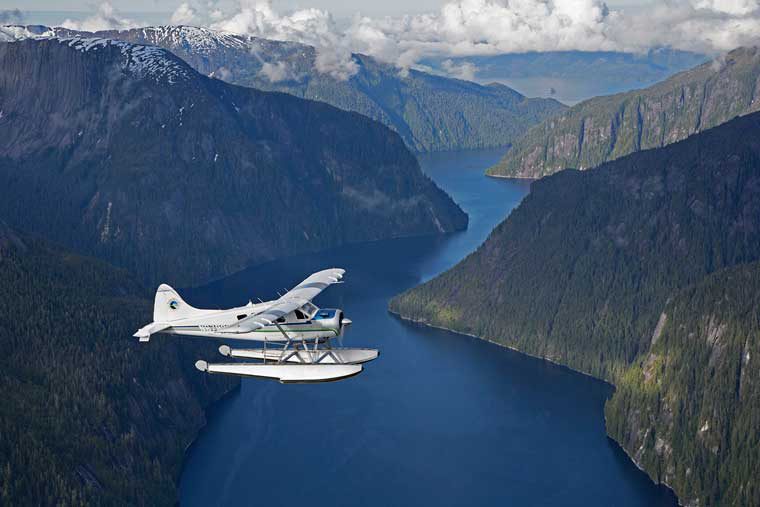
“From Metlakatla to the Misty Fjords — A Day in the Life of an Alaskan Bush Pilot”
By Alex Atkinson Jr.
Back in the 1980s, I had the honor—and I do mean honor—of flying as a commercial seaplane pilot in Southeast Alaska. I was based out of Metlakatla and kept my aircraft docked there five days a week.
My days started early. Real early. I’d be up at 5:00 a.m., and head down to the dock where the airplane—usually a DeHavilland Beaver or sometimes a 185—had spent the night tied up, resting after a long day before. The quiet of those early mornings, the dock creaking softly, the scent of saltwater and spruce in the air—it was something special. I’d perform my preflight check while the world was still half-asleep.
Once ready, I’d fire up the engine while still tied to the dock, letting her warm up for that first flight of the day. By 6:30 a.m., I’d taxi the aircraft out into the open bay, perform my pre-takeoff checks, and begin my takeoff run. Within moments, I’d lift off the water, leaving Metlakatla behind and heading for Ketchikan—a short 12-minute hop over some of the most stunning terrain on the planet.
Ketchikan’s harbor would already be humming by the time I landed and taxied in. I’d tie up, refuel, and prepare for the first tour flight of the day. On busy mornings, our operation was a well-oiled machine: up to 10 planes heading out in the first rotation to the Misty Fjords National Monument.
We had a fleet that could move people. The DeHavilland Beavers carried five passengers. The Otters took ten. The Cessna 185s held three. Each flight lasted about 75 minutes, and we’d brief our passengers before departure—headsets on, smiles wide, cameras ready.
Then came the show.
One by one, aircraft would taxi out and line up, ready to depart for the Fjords. It was a ballet of sorts—15 planes moving in rhythm over the water, headed into what we all knew was God’s country.
As we climbed to cruising altitude—anywhere from 1,500 to 4,000 feet—we’d begin our narration, chatting with our guests over the intercom. We’d round Mountain Point, heading toward Rudyard Bay, the entryway into the Misty Fjords.
Flying beside towering cliffs and deep green valleys, we’d point out waterfalls, ridgelines, glaciers, and wildlife. Eagles. Bears. Maybe even a whale breaching in the distance.
The highlight? Landing on a secluded bay or alpine lake, shutting the engine down, and letting the passengers step out onto the pontoons. The looks on their faces—pure wonder. They’d take photos, videos, breathe in the stillness. Ask questions. Soak it all in.
After 5 to 10 minutes, we’d load everyone back up, take off once again, and make the return trip to Ketchikan.
When we landed, there were always smiles. Always thank-yous. They had just experienced something few people in the world ever will—Alaska, seen from the sky, felt on the water.
It’s hard to describe the feeling you get flying seaplanes in Southeast Alaska. The scenery never gets old. The job, though demanding, was more like a calling. A life of adventure, of responsibility, of deep connection to this place.
Looking back now, I realize how lucky I was. The life of an Alaskan Seaplane Pilot was more than a career—it was a front-row seat to something truly magnificent. And I wouldn’t trade that experience for anything.
Want more stories like this?
Sign up for updates, aviation tales, and behind-the-scenes posts from Alex’s time in the sky and on the water.
 Notes from Alex