
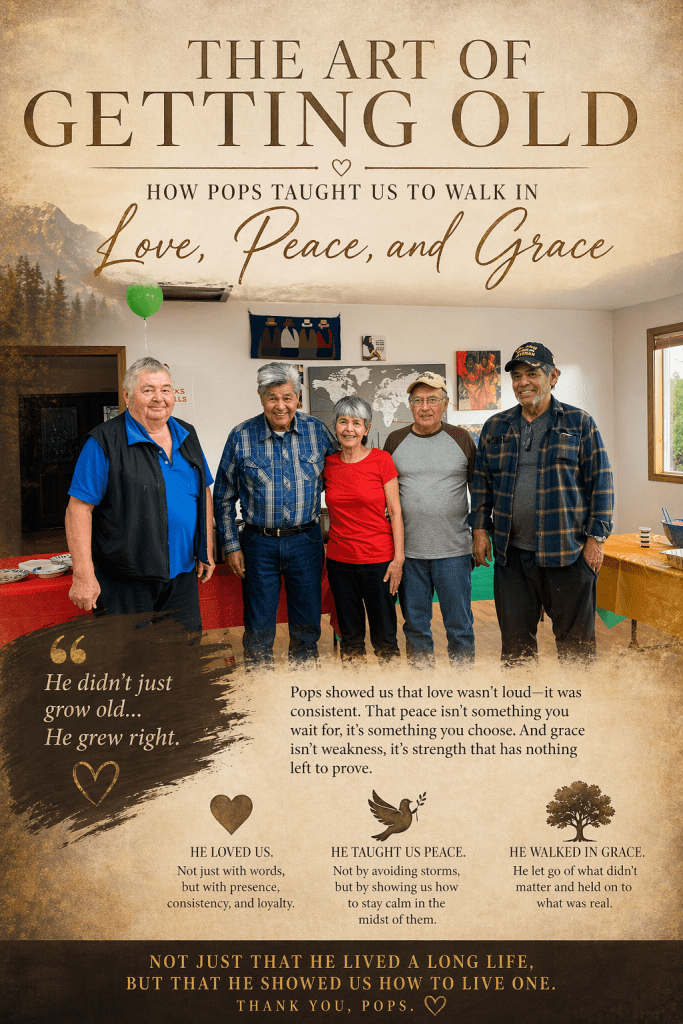
Subtitle: How Pops Taught Us to Walk in Love, Peace, and Grace
There’s a quiet truth most people don’t talk about: getting old is not something that happens to you—it’s something you learn to do.
And if that’s true, then Pops was a master of it.
I didn’t always understand what I was watching when I was younger. Back then, he was just Pops—steady, calm, always there. But looking back now, I realize I was witnessing something rare: a man who didn’t just grow old… he grew right.
He didn’t fight time. He walked with it.
Where most people harden with age, Pops softened. Not in weakness—but in strength that had nothing left to prove. He didn’t raise his voice to be heard. He didn’t demand respect. He carried himself in a way that made you want to listen, want to sit a little longer, want to understand.
He taught us that love wasn’t loud.
Love was consistency.
Love was showing up.
Love was how you treated people when there was nothing to gain.
There were no big speeches. No long lectures about how to live life. Pops taught through presence. Through the way he handled people. Through the way he carried himself in both good times and hard ones.
And there were hard ones.
But even then, I don’t remember him becoming bitter. I don’t remember him letting anger take root. If anything, the storms of life seemed to polish him, not break him. Like driftwood shaped by the tides, he became smoother, calmer, more grounded.
That’s where the grace came from.
Not perfection—grace.
He showed us that peace isn’t something you find out in the world. It’s something you choose to carry inside you. And once you have it, you protect it. Not everything deserves your energy. Not every situation deserves your reaction.
That was one of his greatest lessons:
You don’t have to respond to everything.
You don’t have to carry everything.
You don’t have to become everything people expect you to be.
Just be steady. Be kind. Be real.
And above all—walk in love.
That phrase sounds simple, but Pops lived it out in a way that made it real. He treated people with dignity, whether they had something to offer or not. He didn’t divide people up into categories of worth. To him, people were people—and they mattered.
That kind of love stays with you.
It shapes how you move through the world.
How you speak.
How you forgive.
How you let go.
Because Pops also taught us something else—something just as important:
Grace isn’t just how you treat others. It’s how you learn to treat yourself.
As the years went on, you could see it in him. The way he let go of things that didn’t matter. The way he didn’t carry regret like a burden. The way he made peace with time instead of chasing it.
He didn’t cling to the past.
He honored it.
And then he kept moving forward—with humility, with quiet strength, with grace.
That’s the art of getting old.
It’s not about fading away.
It’s about becoming distilled—everything unnecessary slowly falling off, leaving only what’s true.
And what was true about Pops was this:
He loved his family.
He valued peace.
And he chose grace—again and again, every single day.
Those lessons didn’t come from a book.
They came from watching him live.
And now, they live in us.
In the way we treat each other.
In the way we carry ourselves.
In the way we choose love when it would be easier not to.
That’s his legacy.
Not just that he lived a long life…
But that he showed us how to live one.
And if we carry that forward—if we walk in love, protect our peace, and extend grace the way he did—then a part of Pops will never grow old.
It will keep living, right here, in the way we choose to be.


Leave a Reply