
Aviation Dispatches
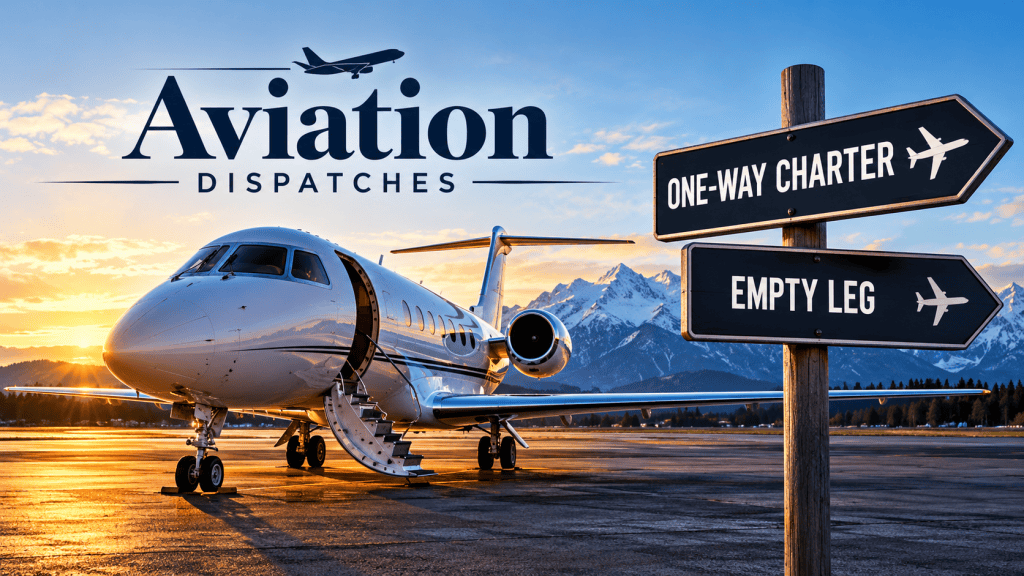
How aircraft positioning, scheduling, and flexibility can make the difference between a full-price charter and a discounted private jet flight.
In the private jet charter business, two terms that often catch a customer’s attention are one-way charter and empty leg. Both involve flying in one direction, but the difference in how they’re priced can be substantial.
After years in charter sales and dispatch, I’ve learned that understanding the difference can save a customer a considerable amount of money—or help them avoid a travel headache.
Let’s look at how it works.
A One-Way Charter: You’re Paying for the Trip
Imagine a client calls requesting a private jet from Teterboro, New Jersey, to Aspen, Colorado, for a holiday weekend.
They have a specific departure date, a preferred time, and six passengers ready to go.
That’s a traditional one-way charter. The client is requesting an aircraft to meet their schedule and take them from Point A to Point B.
The operator has to consider where the aircraft is located, whether it needs to be repositioned, crew availability, fuel, airport fees, and the overall cost of completing the trip.
If the aircraft is sitting in another city, it may need to fly to Teterboro before picking up the passengers. After dropping them off in Aspen, it may need to reposition again for its next assignment.
Those costs influence the final quote.
A one-way charter doesn’t necessarily mean the customer is paying for the entire round trip, but the operator must account for the aircraft’s movements and expenses to make the trip work.
An Empty Leg: You’re Taking Advantage of a Flight Already Scheduled
Now let’s flip the situation around.
An aircraft has just completed a charter from New York to Aspen. The passengers have arrived, but the aircraft needs to return to New York for another assignment.
That return flight is an empty leg.
The operator already has a reason to move the aircraft. Rather than flying it without paying passengers, the operator may offer the trip at a discounted price to someone willing to travel that route.
This is where the savings can become substantial.
The operator is generating additional revenue from a flight that was already scheduled, while the customer gets access to private aviation at a potentially much lower price.
But there’s a catch.
With an empty leg, the customer works around the aircraft’s schedule—not the other way around.
The departure time, route, and availability are much less flexible. And if the original charter changes or cancels, that empty leg may disappear altogether.
Why the Price Difference?
Let’s use a hypothetical example.
A one-way charter from Aspen to Teterboro might be quoted at $28,000. An empty leg on that same route might be advertised for $12,000.
Why the difference?
Because the operator may already have accounted for the aircraft’s movement in its existing schedule. The empty-leg customer is helping recover some of the cost of a flight that would otherwise carry no paying passengers.
The traditional one-way charter, on the other hand, requires the operator to evaluate the cost and profitability of fulfilling a new request.
These prices aren’t guaranteed, of course. Sometimes a one-way charter can be surprisingly competitive if the aircraft is already positioned nearby or the operator has a favorable schedule.
The Bottom Line
If you have a specific destination and departure time that cannot change, a traditional one-way charter is probably your best option.
If your schedule is flexible and you’re willing to work around an aircraft’s existing movements, an empty leg might offer a substantial savings.
In charter sales and dispatch, we’re always looking at aircraft availability, positioning, timing, and the economics of making a trip work.
Sometimes the best opportunity isn’t arranging a flight from scratch. It’s finding the right customer for an aircraft that’s already going somewhere.
And that’s one of the things I love about this business: the right timing can make all the difference.


Leave a Reply