
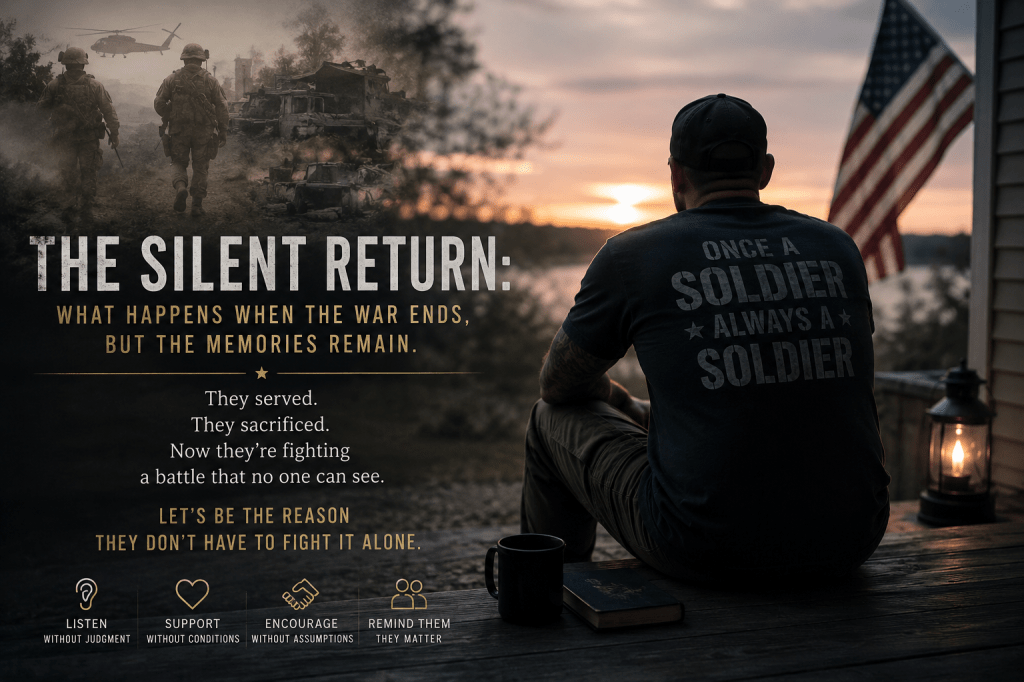
The Silent Return: Life After War
There are men and women across America who have carried the burden of war on their shoulders. They answered the call to serve, leaving behind their homes, families, and normal lives to step into environments most people will never fully understand. They saw things that changed them forever. They experienced loss, fear, chaos, and moments that no training could ever truly prepare a person for.
And then, one day, they came home.
To many civilians, homecoming is imagined as a joyful return — family reunions, hugs at the airport, celebrations, and relief. But for many veterans, the journey home is far more complicated than the moment the plane touches down.
Because while the body may return home, parts of the mind and spirit can remain overseas.
War leaves behind memories that do not simply disappear with time. Many veterans return carrying invisible wounds — experiences too painful to explain and too heavy to ignore. Some struggle with anxiety, depression, hypervigilance, or survivor’s guilt. Others battle sleepless nights and memories that replay without warning. The world around them continues moving forward, yet internally, they may still be standing in moments they cannot forget.
For many soldiers, this becomes a silent season of life.
A season where they try to adjust back into everyday routines while carrying extraordinary emotional weight. They sit at dinner tables, go to work, attend family gatherings, and smile in conversations, all while quietly fighting battles nobody else can see.
The difficult truth is that many veterans feel misunderstood once they return home. Civilians often want to thank them for their service, but few truly understand the emotional cost of what service sometimes requires. And because of that gap in understanding, many veterans choose silence instead of vulnerability.
Some isolate themselves.
Some bury their experiences deep inside.
Some convince themselves they simply need to “be strong.”
But strength does not mean suffering alone.
Healing is not a straight road, and every veteran walks it differently. Some find peace through counseling, faith, friendships, family, or support groups with fellow veterans who understand the unspoken realities of combat. Others rediscover purpose through helping younger veterans navigate the same struggles they once faced themselves.
The most important thing society can do is create space for understanding.
Not judgment.
Not political debate.
Not assumptions.
Just understanding.
Sometimes the most powerful thing a person can offer a veteran is presence — a willingness to listen without trying to fix everything. A reminder that they are not weak for struggling. A reminder that asking for help is not failure. A reminder that they are still needed, valued, and appreciated beyond their military service.
The reality is this: many veterans return home changed forever. War reshapes people in ways that cannot always be seen from the outside. But they should never have to carry those burdens alone.
These men and women gave pieces of themselves in service to something larger than themselves. The least society can do in return is stand beside them when the uniform comes off.
Because sometimes the strongest soldiers are the ones quietly fighting to find peace long after the war has ended.


Leave a comment