Our Culture Can Become the Bridge Between the Pain of Yesterday and the Hope of Tomorrow.
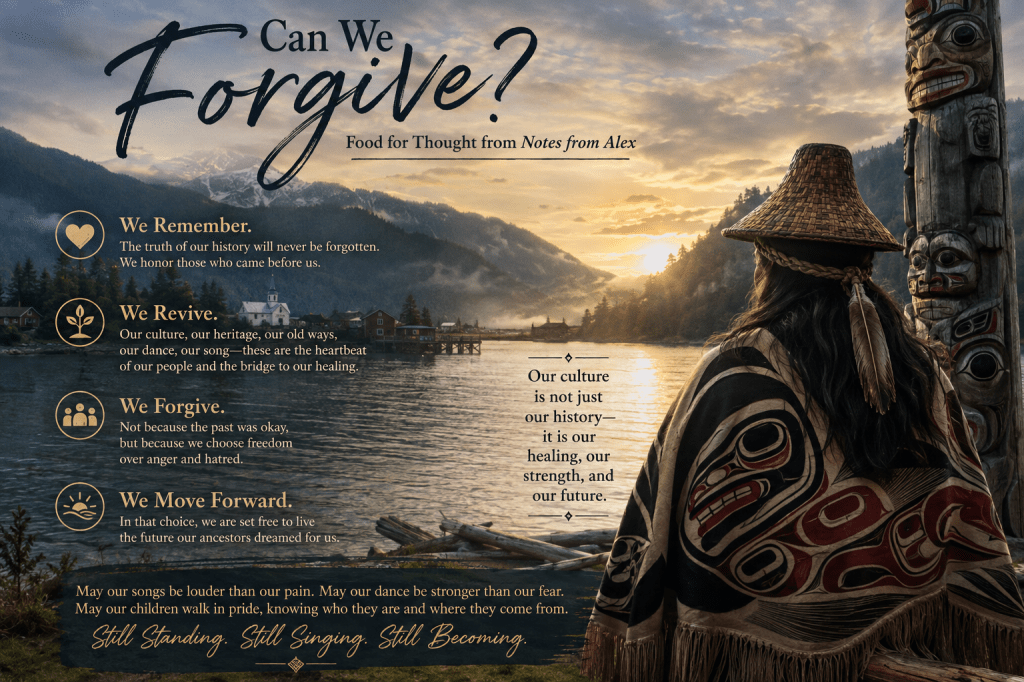
Food for Thought from Notes from Alex
I live in a small Native village in Southeast Alaska.
Maybe that is why, as I have been reading and studying more about Native villages across our land, I have found myself thinking deeply about something that is difficult to talk about.
The discoveries of the last century are, in many ways, heartbreaking.
We have uncovered stories of children taken from their families, languages forbidden, traditions suppressed, songs and dances discouraged, and entire generations taught that the culture of their ancestors was somehow less than the culture being imposed upon them.
There were people and institutions who believed they were doing what was right. They believed Native people needed to be changed, educated, civilized, or brought into a different way of life.
But somewhere along the way, something important was lost.
Our people already knew how to live upon these lands.
We knew the waters. We knew the seasons. We knew the animals, the plants, the tides, the weather, and the responsibilities that came with living in relationship with the land.
We had our own languages.
Our own songs.
Our own dances.
Our own stories.
Our own systems of family, community, leadership, and responsibility.
We had a way of life that had sustained our people for countless generations.
And then someone arrived and decided that their way was better.
That is a difficult history to carry.
But there is another question that I have been wrestling with lately.
How do we forgive?
How do we forgive people who participated in, or supported, systems that tried to erase our culture?
How do we forgive those who believed our languages should disappear, our traditions should be abandoned, and our children should be separated from the teachings of their ancestors?
And perhaps the hardest question of all:
How do we forgive those who tried to destroy the very identity of our people?
I don’t pretend to have the answer.
But perhaps forgiveness does not mean forgetting.
Maybe it does not mean pretending that terrible things did not happen.
Maybe forgiveness does not mean excusing the people who caused the harm.
Perhaps forgiveness begins with telling the truth.
We have to remember.
We have to tell the stories.
We have to listen to our Elders.
We have to preserve our languages, our songs, our dances, our history and our traditions.
We have to teach our children who they are and where they come from.
But perhaps there is something even more powerful we can do.
We can bring our culture back to life.
We can revive the language.
We can bring the songs back.
We can dance again.
We can learn the old ways of our ancestors.
We can restore our stories.
We can teach our children the values, knowledge and responsibilities that were handed down to us.
And perhaps in doing so, something beautiful begins to happen.
Our culture can become a bridge for healing.
Not a bridge built on anger.
Not a bridge built on hatred.
But a bridge built on understanding, remembrance, dignity, forgiveness and love for the generations who came before us and those who will come after us.
There is a difference between remembering injustice and living in anger.
We should never forget what happened.
But perhaps we don’t have to allow what happened to become the thing that controls who we are today.
Anger can tell us that something was wrong.
It can awaken us.
It can motivate us to stand up and protect what matters.
But if we allow anger and hatred to become our permanent home, then in some way, the wounds of the past continue to control our future.
And I don’t believe that is what our ancestors wanted for us.
I believe they wanted us to live.
To raise our children.
To know who we are.
To walk proudly in our identity.
To respect the land.
To care for one another.
To carry the songs.
To speak the language.
To remember the stories.
To dance.
To laugh.
To gather.
To live.
Perhaps that is where forgiveness becomes powerful.
Forgiveness doesn’t erase history.
It doesn’t erase the pain.
It doesn’t say that what happened was acceptable.
Instead, perhaps forgiveness says:
“You will not control my future anymore.”
And there is freedom in that.
When we choose forgiveness, perhaps we begin to release ourselves from the chains of anger and hatred.
We become free to put our energy somewhere else.
Into rebuilding.
Into teaching.
Into restoring.
Into creating.
Into loving our children and our communities.
Into becoming the people our ancestors hoped we would become.
Were the people who came here perfect?
No.
That much is obvious.
Many did not understand our people, our ways, our relationship with the land, or the importance of our cultural traditions.
Perhaps they thought they were bringing education to people who needed it.
But maybe the truth is that they, too, needed an education.
They needed to learn from the people who had lived here for generations.
They needed to understand that there was knowledge here long before they arrived.
They needed to listen.
And perhaps that is one of the greatest lessons we can carry forward today.
We don’t have to repeat the mistakes of the past in order to remember the past.
We can acknowledge the hurt without allowing the hurt to become the only thing that defines us.
We can remember those who suffered while celebrating those who survived.
We can mourn what was taken while rebuilding what can still be restored.
We can bring our songs back.
We can speak our languages.
We can dance.
We can tell our stories.
We can restore our history.
We can teach our children.
And perhaps, somewhere along that journey, forgiveness becomes possible.
Not because the past was acceptable.
Not because the wounds were insignificant.
But because we choose not to allow the actions of others to control the future of our people.
Maybe the greatest act of resistance isn’t living in anger.
Maybe it is living fully in who we are.
Maybe it is waking up one morning and speaking the language our grandparents were told not to speak.
Maybe it is hearing the drum again.
Maybe it is watching our young people learn the dances.
Maybe it is seeing an Elder smile because a tradition they feared would disappear is alive again.
Maybe it is gathering around the table, telling stories, sharing food, laughing together and remembering that our people are still here.
Still standing.
Still singing.
Still dancing.
Still remembering.
Still becoming.
And perhaps that is where the bridge is built.
A bridge from the pain of yesterday to the hope of tomorrow.
A bridge from loss to restoration.
A bridge from anger to understanding.
A bridge from remembrance to healing.
And maybe, on the other side of that bridge, there is freedom.
Freedom to be who our ancestors always knew we could be.
So I come back to the question.
Can we forgive?
I don’t know.
But perhaps forgiveness isn’t something we have to force.
Perhaps it is a journey.
And perhaps that journey begins by remembering, telling the truth, restoring what was taken from us, reviving what was nearly lost, and then choosing not to let hatred become our inheritance.
Because our inheritance is so much greater than that.
Our inheritance is our language.
Our songs.
Our dances.
Our stories.
Our families.
Our land.
Our waters.
Our traditions.
Our identity.
And perhaps most importantly—
our future.
Maybe forgiveness is not about letting go of the past.
Maybe it is about finally becoming free enough to walk forward.
And perhaps that is exactly what our ancestors wanted for us.
Just some food for thought from Alex.


Leave a Reply