Some things are inherited. Others are entrusted to us.
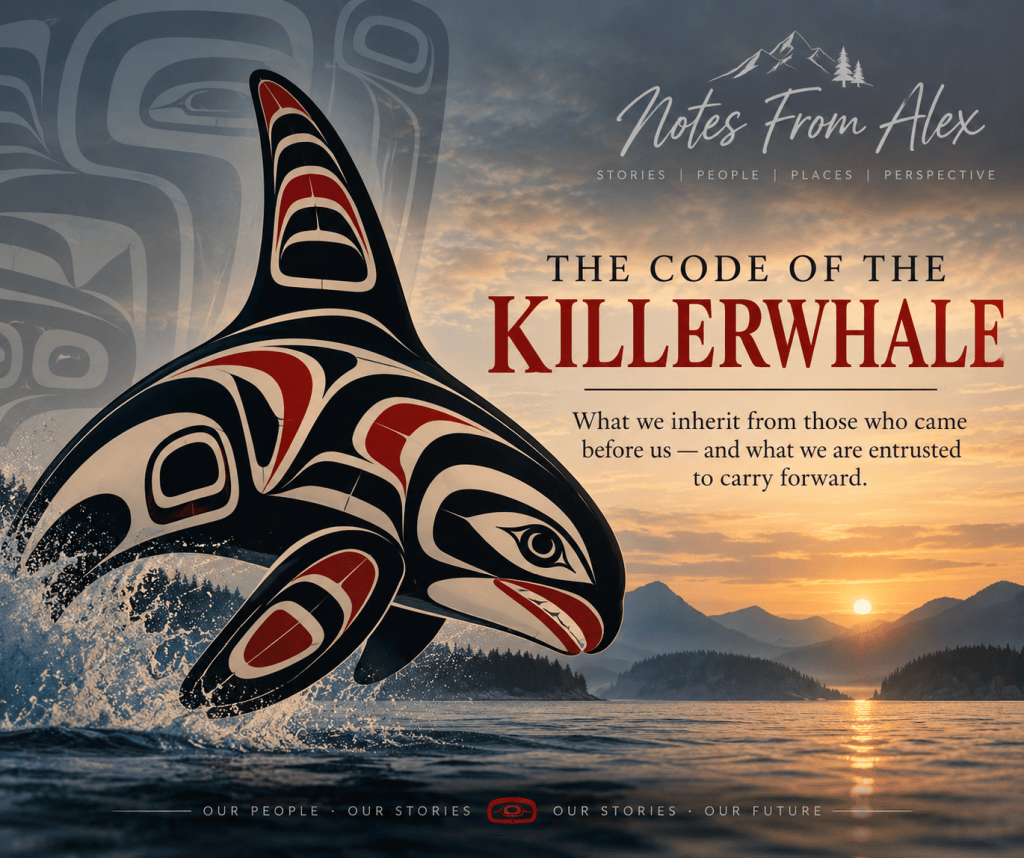
What the Killerwhale Clan taught me about family, belonging, and the responsibility of carrying a name.
There is something about knowing where you come from.
It isn’t simply knowing the names of your grandparents or being able to trace a family tree back a few generations. It is something deeper than that.
It is knowing that you are part of something that existed long before you—and will, if you do your part, continue long after you are gone.
For those of us who come from a clan system, our identity has never been just about ourselves.
We carry a name.
We carry a history.
We carry stories.
And we carry responsibilities.
For me, that connection comes through the Killerwhale Clan.
The Killerwhale is more than an image carved into wood or painted onto a piece of artwork. It represents a connection to family and community—a reminder that we are not individuals standing alone in the world.
We belong to something.
And belonging comes with a code.
The first part of the code is family.
Family isn’t always easy.
Anyone who has lived long enough knows that.
Families disagree. They struggle. People make mistakes. Sometimes we hurt one another without meaning to.
But family remains family.
The old teachings understood something that modern society sometimes forgets: you don’t get to choose where you come from, but you do get to choose what you do with what you were given.
Our ancestors gave us more than names.
They gave us a foundation.
The question is whether we will strengthen that foundation—or allow it to disappear.
The second part of the code is responsibility.
There is a responsibility that comes with being part of a clan.
We are temporary caretakers of something much bigger than ourselves.
The stories we inherit aren’t really ours to keep.
They are ours to carry.
And eventually, they must be passed to someone else.
That means remembering the Elders.
Listening to their stories.
Learning the names of places.
Understanding where our families came from.
Learning the language.
Knowing the meaning behind the designs, the songs, the ceremonies, and the traditions.
Because when an Elder passes away, we don’t simply lose a person.
Sometimes, we lose an entire library.
The third part of the code is strength.
The Killerwhale doesn’t represent strength because it is loud.
It represents strength because it knows how to move with its family.
There is a lesson in that.
Strength isn’t always standing alone.
Sometimes strength means knowing when to stand beside someone.
Sometimes it means protecting the person who can’t protect themselves.
Sometimes it means forgiving.
Sometimes it means showing up when nobody else does.
And sometimes strength means simply refusing to let your history disappear.
The fourth part of the code is remembering.
There is a danger in forgetting.
When we forget our stories, we become disconnected from the people who came before us.
When we forget our language, we lose a piece of the way our ancestors understood the world.
When we stop telling our stories, eventually there is nobody left to tell them.
That is why preserving history matters to me.
It isn’t about living in the past.
It’s about making sure the future knows where it came from.
Every photograph.
Every handwritten document.
Every story told by an Elder.
Every family name.
Every old building.
Every piece of artwork.
Every song.
Every word of Sm’algyax that we preserve is another thread connecting generations.
And those threads matter.
Perhaps that is the real Code of the Killerwhale.
Remember who you are.
Know where you come from.
Protect your family.
Respect your Elders.
Carry your stories.
Teach the next generation.
And never be ashamed of the people who came before you.
I think about that more as I get older.
When you’re young, you spend a lot of time trying to figure out who you are.
As you get older, you begin to realize that perhaps the answer was there all along.
It was in the stories.
It was in the people.
It was in the places.
It was in the names.
It was in the generations that came before you.
And somewhere along the way, you realize that your job isn’t simply to discover your identity.
Your job is to carry it forward.
That is what the Killerwhale means to me.
Not simply a clan.
Not simply a design.
Not simply a symbol.
But a reminder.
A reminder that we belong to one another.
A reminder that our ancestors are still part of our story.
And a reminder that one day, whether we realize it or not, someone younger will be looking to us to tell them what we remember.
So we have a choice.
We can let the stories disappear.
Or we can carry them.
We can preserve them.
We can tell them.
And we can pass them on.
Because that is the code.
The Code of the Killerwhale.
— Alexander Atkinson Jr. Editor, – Stories From The Heart


Leave a comment