“Where history meets healing, culture finds its way home, and the future remains unwritten.”
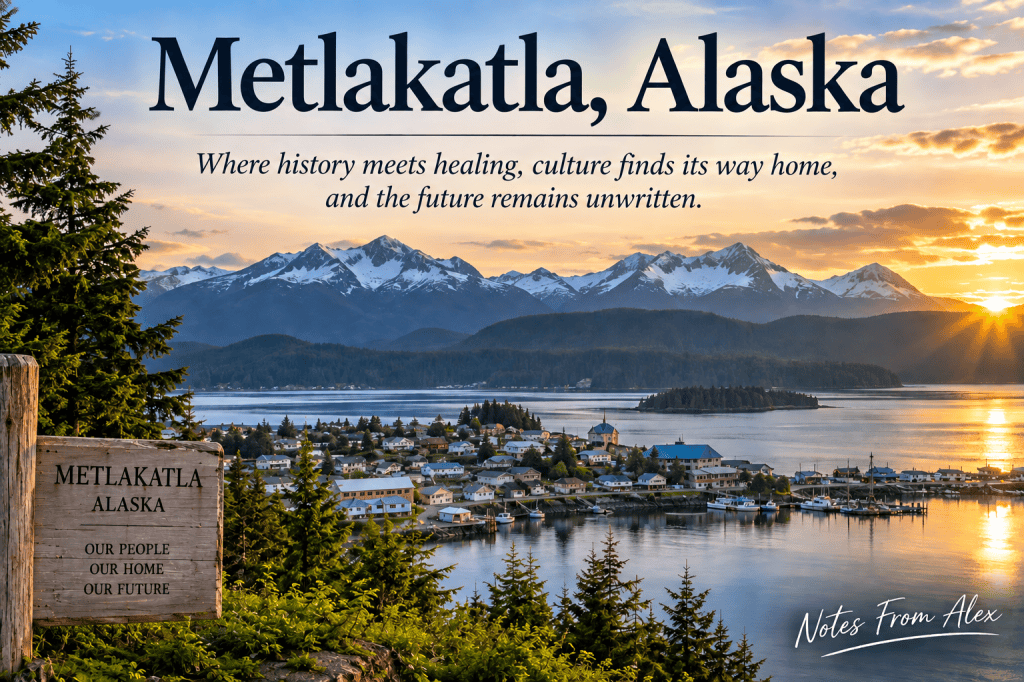
There is something about Metlakatla that has always captured my heart.
Maybe it is the water surrounding Annette Island. Maybe it is the mountains, the forests, and the feeling that you are standing in a place where generations of people have lived, worked, raised families, and built a community.
But more than anything, I think it is the people.
Metlakatla is home to the Tsimshian people of Alaska, whose ancestral roots reach across the waters to the coast of what is now northern British Columbia. The community we know today as Metlakatla has a relatively recent history in Alaska, but the Tsimshian story is much older.
In 1857, William Duncan, an Anglican lay missionary, established a mission among the Tsimshian people in British Columbia. About thirty years later, in 1887, Duncan led 823 Tsimshian people from Old Metlakatla in British Columbia to Annette Island, where they established what became known as New Metlakatla.
Duncan had a vision for the community. He wanted to build a structured, self-sufficient community and encouraged economic activities that he believed would prepare the Tsimshian for the changing modern world.
But there was also a tremendous cost.
Traditional cultural expressions were discouraged, and over time, portions of the Tsimshian language, traditions, ceremonies, and cultural practices were diminished or lost.
Yet the story did not end there.
Culture has a remarkable way of surviving.
Today, there is a renewed effort among Tsimshian people to reconnect with and restore traditions—language, dancing, potlatching, carving, regalia, art, and the stories that connect families and clans across generations.
That restoration means something to me.
I look at the history of Metlakatla and I see things that are difficult. There are parts of our history that I don’t necessarily appreciate, and there are things that I wish had happened differently.
But I also believe we have to be careful not to allow the painful parts of history to become the only story we tell.
History should teach us.
It should remind us.
It should help us understand why things are the way they are.
But I believe healing comes when we can acknowledge the past without allowing it to hold the future hostage.
That is what I hope for Metlakatla.
I hope we continue to remember the people who came before us. I hope we honor the Tsimshian culture, the families, the clans, the artists, the storytellers, the elders, and the young people who will carry these traditions forward.
I hope we continue restoring what can be restored.
And I hope we can build something together that future generations will look back upon with pride.
The sea and the forests around Annette Island are not simply beautiful scenery. They are part of the identity of this place. They have provided food, work, inspiration, and a connection to the land and water for generations.
And the art of the Tsimshian—the formline designs, carvings, regalia, poles, panels, and representations of the animals and birds connected to clans and families—is more than artwork.
It is history.
It is identity.
It is memory made visible.
That is why I love the history of Metlakatla.
Not because every chapter is easy.
It isn’t.
I love it because there is still a story being written.
A story about people who endured change, held onto pieces of who they were, and are now working to bring more of their culture back into the light.
And perhaps that is what healing really looks like.
Not forgetting.
Not pretending the difficult things never happened.
But remembering, learning, rebuilding, and choosing to move forward together.
When I think about Metlakatla, I don’t just think about its past.
I think about its people.
I think about its future.
And I think about what we can leave behind for the generations who come after us.
Metlakatla is more than a place on a map. It is a community with a story, a culture with a history, and a people with a future.
And I hope that future is filled with pride, healing, respect, and a renewed connection to the traditions that make Metlakatla unique.
Notes From Alex
Sometimes loving a place means loving its history—the beautiful parts, the difficult parts, and everything in between.
We cannot change yesterday.
But we can choose what we do with tomorrow.
And for Metlakatla, I believe there is still so much good ahead.
— Alex


Leave a Reply